About Us

Monday, October 12, 2015

What To Expect During Nursing School

"There is nothing easy about going through nursing school," was a common response I received from nurses I've met in the past. For such a high pressure job, I've assumed it would not be an easy task, since the lives of each person are in our hands. As I'm only a pre nursing major this year, I truly do not know what to expect as a prospective nursing student. With this, I decided to look into what I can expect, and relay that information to those of you who are reading this.

The first thing you can expect is classroom course work. As a nurse, you must have a broad range of knowledge. You can expect to take classes such as chemistry, psychology, anatomy, nutrition and microbiology. As a freshman, I'm currently enrolled in a general chemistry, college algebra, anatomy and biology, all of which are prerequisites required for admission into the nursing program at Michigan State University. It's important that through these courses, we gain critical thinking skills, communication skills and backgrounds in social sciences, that way we have background for future job requirements.

Another thing we will participate in are labs, where we are free to practice skills we learn via our courses. A simulation lab is used for students to apply theoretical knowledge in a simulated medical facility. This basically allows us to practice safely on simulations, rather than on real people. The best way to learn is by experiencing different scenarios hands on, which is why this is a huge part of the nursing school curriculum.
(Here is a picture of a simulation lab. You can see that they use dummies, rather than people.)

After labs, we will be able to come into contact and work with real, living people through clinicals. For Michigan State, this will occur in the junior and senior years. By completing clinicals, we are gaining the necessary medical experience we must have to make decisions and dealing with real life patients. All clinicals are completed under the supervision of a qualified registered nurse. A certain number of hours must be completed to graduate from nursing school. Specifically at Michigan State, we are required to complete 736 hours of clinical hours before graduation. According to OCadiz (2015), "During clinical rotations, nursing students visit various departments such as obstetrics, adult health, pediatrics, surgery, geriatric and mental health clinics to learn hands-on skills."


After reading through this list of what to expect in nursing school, I'm excited to take on these challenges I'll face. I also gained knowledge on why it takes a special person to become a nurse: it is truly a tough but rewarding job. The following quote is one I found to be most influential towards my attitude to nursing school.  Next time you are in a doctors office, think about all of the things that nurses had to go through in order to take care of you efficiently. There is certainly nothing easy about this job! "If it wasn't hard, everyone would do it. It's that hard that makes it great." Till next time!
-Brooke B. 

RESOURCE:
OCardiaz, M. (2015). What to expect during nursing school.  
Retrieved from: http://classroom.synonym.com/expect-during-nursing-school-5296.html.

Sunday, October 11, 2015

Nurse Practitioner

What is a Nurse Practitioner?
Nurse practitioners are able to treat patients, without the guidance of doctors. They continue their education after receiving their bachelors in the science of nursing, BSN. They look at the patients health history, examine, diagnose, and treat  the illness. They are qualified to interpret lab results, x-rays, prescribe medications, treat illnesses, and refer patients if necessary (Mayo Clinic).

How do you become a nurse practitioner?
After nursing students complete their bachelors degree, take their certified National Council Licensure Exam to become a registered nurse, they continue their education and acquire a masters degree.

What is their salary?

Level of experience, specific field, and years of employment are just a few factors that influence salary, but on average nurse practitioners make around $93,000 a year (Indeed.com).

-Casey W
-
"Mayo School of Health Sciences." Nurse Practitioner. Mayo Foundation for Medical Education and Research, 20 Jan. 2014. Web. 11 Oct. 2015.
"Nurse Practitioner Salary in Michigan." Nurse Practitioner Salary in Michigan. Indeed, n.d. Web. 09 Oct. 2015.


Wednesday, October 7, 2015

Military Nurse

How is military nursing different from nursing in general?

A military nurse shares common characteristics and responsibilities as a regular nurse, however there are differences.  For instance, working in more of a comfortable atmosphere in a hospital, a military nurse has to be trained to work in military environments which can be really dangerous.


What makes military nursing special?

Military nursing provides people with not only the opportunity to help a normal person, but a person fighting for his/her country.  How cool is that! For those interested in nursing, I think they should consider working as a military nurse to save lives of those fighting for ours.  Some benefits of this career include traveling the world to different war zones.  There it is.  There is the disadvantage of this occupation, foreign war zones.  However, I do not think that should be a determining factor for those looking for a career in the field of nursing.  Think about it more this way: working as a military  nurse benefits soldiers and the country.


How do you become a military nurse?

To become a military nurse requires the same requirements as a regular nurse.  However the advantage is that a majority of your education and other licensing expenses are covered by the government! The only  other addition to academic requirements is to go through officer training.  There is where you will learn how to work in the military environments.

-Samantha B


Sources: http://nursewithoutborders.org/becoming-a-military-nurse/

"Becoming a Military Nurse." NurseWithoutBordersorg. Nurse Without Borders, n.d. Web. 07 Oct. 2015

Tuesday, October 6, 2015

Prepared for Disaster?

After natural and unnatural disasters that send people into chaos, we want to be better prepared for the next one. For a better example, after hurricane Katrina hit the Gulf Coast nurses and other aids created disaster plans. Businessdictionary.com defines a disaster plans as systematic procedures that clearly detail what needs to be done, how, when, and by whom before and after the time an anticipated disastrous event occurs. Surprisingly one of the first things they asked the nurses to do was rest, without proper rest they can't think straight. After proper rest they were put straight to work, working with many patients to one nurse. Nurses help with Katrina showed the public the importance of nurses, and proved that they are more valuable than the public once thought. There has been many policies made since Katrina and other disasters have happened. Along with disaster plans, there are disaster preparation rules and regulations.

In case of any emergency within the hospital, the nurses are trained for mostly any possible problem or disaster. The reason they go through nursing school is to prepare them for anything that comes their way. If it is something new they are facing, nurses are very passionate, caring, and smart people who know how to take action when need be. If you want to read more about nurses and their preparedness policy go to this link. http://www.nursingworld.org/MainMenuCategories/Policy-Advocacy/Positions-and-Resolutions/Issue-Briefs/Disaster-Preparedness.pdf

I believe it is a really good thing to be prepared for everything, especially as a nurse. It is good that there is many plans and precautions for when disaster strikes.
Kyra T.
Sources: "Katrina's Chaos Teaches Powerful Lessons about Disaster Prep." News. N.p., 01 Sept. 2015. Web. 06 Oct. 2015

Prompt 9: How Imperative Nurses Are

"Constant attention by a good nurse can be just as important as a major operation by a surgeon", this statement was made by a UN Secretary General, and was the opening statement in the news story I watched. This attention from nurses is getting harder to come by, and in America we are running about 100,000 nurses short (video). As the population gets older and sicker, this nursing shortage is expected to increase. The nursing shortage shows us just how important nurses are to keep patients alive and hospitals running. This news story takes viewers inside of a the busiest hospital in New York,  New York Presbyterian Hospital, to uncover the truth of how imperative nurses are.

Story 1: We follow nurse Mary Grace Savage and her patient Nicole Marquez, who fell down 5 stories, broke her neck, back, pelvis, ribs, and punctured a lung.  In the video it says, "Popular culture often depicts the work of doctors heroically, what is too is often over looked however is the essential role of nurses. Who is the case of Nicole Marquez care for their patient constantly, and by constantly we mean constantly, monitoring, managing, responding, day and night". Nurses keep the communication following, whether it's to doctors or family members. Right away nurses are there walking patients and their families through what is going on. In Nicole's case the nurses patiently go through the alphabet so she can pick out certain letters and they from there. After a month of constant care and attention, they were able to remove the breathing equipment from her mouth, she was then moved to a rehabilitation facility. They once feared that she wouldn't be able to survived her fall, let alone walk or raise her arms, but a year later she walked back into New York Presbyterian and hugged her nurses.

Casey W.

Link to the video:
http://www.jonascenter.org/news/post/nurses-needed-a-now-on-pbs-documentary-supported-by-jonas-center-explores-nursing-shortage

Sunday, October 4, 2015

Female Vs. Male Nurses

There are many more women nurses than there is male nurses. The ratio of female to male nurses is approximately ten to one. People argue that male nurses are better than female nurses, but that is based on the patients opinions and not factual evidence. Personally I think it would depend on who is taking care of you. Because if your nurse is grumpy, whether they are male or female does not matter, they're still grumpy. Also what type of schooling the nurse has gone through matters, and that is the person's choice. Male nurses usually chose the bigger paying jobs and because of that they make more money. This is similar to the controversy in the STEM (Science, Technology, Engineering, Math) field we had our talk topic on, except in STEM there is more males than females. There is a lot of stereotyping behind the word nurse, just like when you think of a scientist. I even think of a female whenever anyone is speaking of a nurse unless the specify "male nurse." According to UCSF. edu website male nurses make at least $5,000 more than females do a year.
Kyra T.

Thursday, October 1, 2015

Trauma Nurse

What is a trauma nurse?

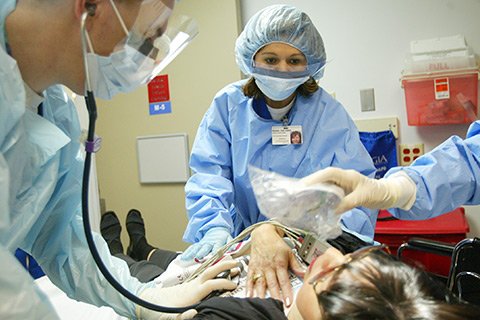
A trauma nurse is often someone you would find in the emergency room. These nurses specialize in working with patients who may not know the cause of their illness or injury; in other words, with patients in need of urgent care.


What do they do?

Trauma nurses work in a fast paced environment in which they may be required to perform surgical procedures, or just have experience in critical care situations.  Many patients in the trauma center require constant supervision; whether it be persistently monitoring their vitals, giving constant ventilation, changing/exchanging IVs as necessary, cardiac monitoring, and many other aspects of maintaining stability in patients.  These tasks are mainly done by the trauma nurse.


Who makes a good trauma nurses?

A good trauma nurse is someone who can manage stressful situations quickly and efficiently.  Working in the trauma center is a job that demands patience and understanding due to a multitude of conflicts including: language barriers, grieving of the family and friends, high pressure environment, and the duty to remain calm and focused in such a chaotic environment.  To be a quality trauma nurse, one needs to be able to manage stressful situations as organized as possible to ensure the doctors, surgeons, patients, and families that everything is under control.

Why do I want to become a trauma nurse?

Not to sound like a common medical student, but I absolutely love Grey's Anatomy.  The thrill of the situations encountered in the show motivate me to hopefully one day work in the ER.  Now I know it is just a show, however that does not mean life is not that exciting outside Hollywood!  The main reason I would like to become a trauma nurse is to have the opportunity to expose myself to the tragedies that occur everyday and be able to help those in need.  I would love to save lives so that families do not have to grieve over losing a loved one in an accident and I believe the trauma center can use all the helping hands it can get!

-Samantha B.


Source: http://www.nurse.com/students/CareersInNursing/Specialties/TMN.htm